September 16, 2026


By: AJ Gutierrez, Alaina Boyle Ph.D., and Elizabeth Sykes
Schools invest enormously in people. Teachers, counselors, coaches, school leaders, advisors, and other staff members spend every day building relationships with students. But how often do we actually know which relationships matter most to a particular student?
Several years ago, Equal Opportunity Schools began asking students a simple question: Which adults in your school do you trust to give you good advice about important decisions or classes? We originally collected this information for a practical reason. If a student was ready for an advanced course but hesitant to enroll, we wanted to know who might be best positioned to talk with them. Over time, we accumulated something much larger. Across our work with schools, students had identified trusted adults again and again. That created an unusual opportunity to learn more about how trust actually operates inside schools.
In 2022, EOS partnered with the Center for Trust and Transformation to explore that question more deeply. The resulting research helped us see both the extraordinary potential of relationships and something else that is equally important — an understanding that a relationship is an asset, but schools still have to know how to activate it.
Looking at trust at an unusual scale
The Center for Trust and Transformation analyzed EOS data from 2016 through 2020, encompassing more than 1.8 million student records, 77,000 staff records, 1,404 schools, and 450 districts. The analysis included student and staff survey information, administrative data, advanced course enrollment, GPA, educator recommendations, and student-identified trusted adult relationships. This was an exploratory analysis rather than a causal study. The goal was to look for patterns, test hypotheses, and identify questions worthy of deeper research.
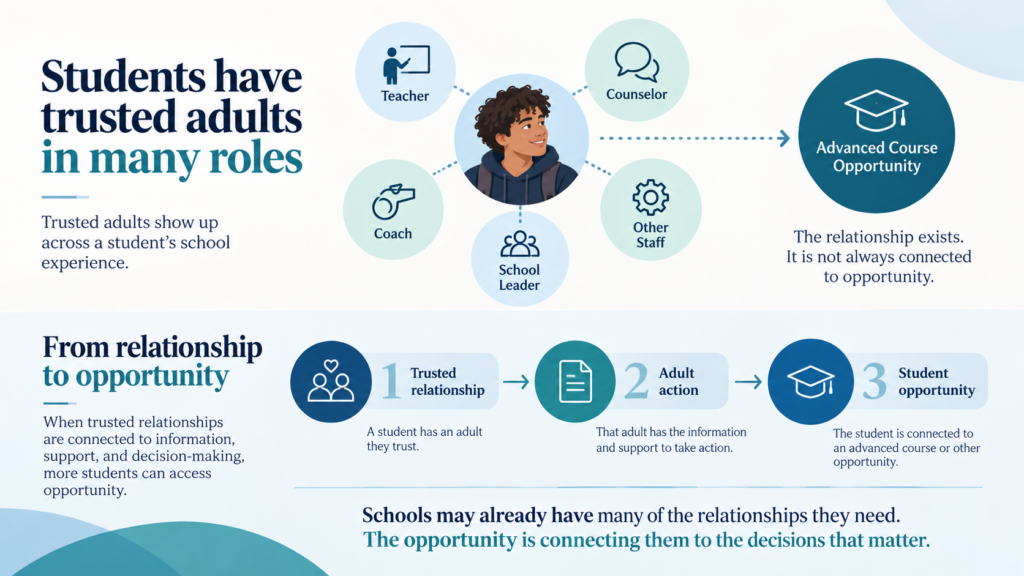
Some of the first findings were reassuring. Across the years studied, an average of 77 percent of surveyed students reported having a trusted adult in at least one year. Teachers were the most commonly named trusted adults, but students also named counselors, coaches, school leaders, office staff, custodians, and many other adults throughout the building. That breadth matters because it suggests that the network of adults who can influence a student is much larger than the group we typically consider when schools make academic decisions.
But the data also showed that access to those trusted relationships was not evenly distributed. Black, Indigenous, Latinx, and Hawaiian or Pacific Islander students consistently reported having a trusted adult at lower rates than White and Asian students. The study also found that students were more likely to identify a trusted adult who shared their racial or ethnic background. The analysis cannot tell us exactly why those patterns exist. Trust is complicated. It develops through individual interactions, school culture, shared experiences, expectations, identity, and many other factors. But the disparities are difficult to ignore. They suggest that when we talk about whether every student has an adult who knows them, believes in them, and can help them navigate school, we should not assume that experience is equally available to everyone.
Having a trusted adult is not enough
One of the most interesting findings came from asking whether trusted relationships actually translated into opportunity. Were the adults students trusted also the adults recommending them for advanced courses? If trusted adults are an important source of influence, we might expect those relationships to play a meaningful role in helping students access advanced coursework. But in most cases, they did not.
Among students eligible for an advanced course recommendation, only about 12 percent of trusted adult relationships also included a recommendation from that adult. Looking from the other direction, only 19 percent of educators who recommended a student were identified as trusted by that same student.
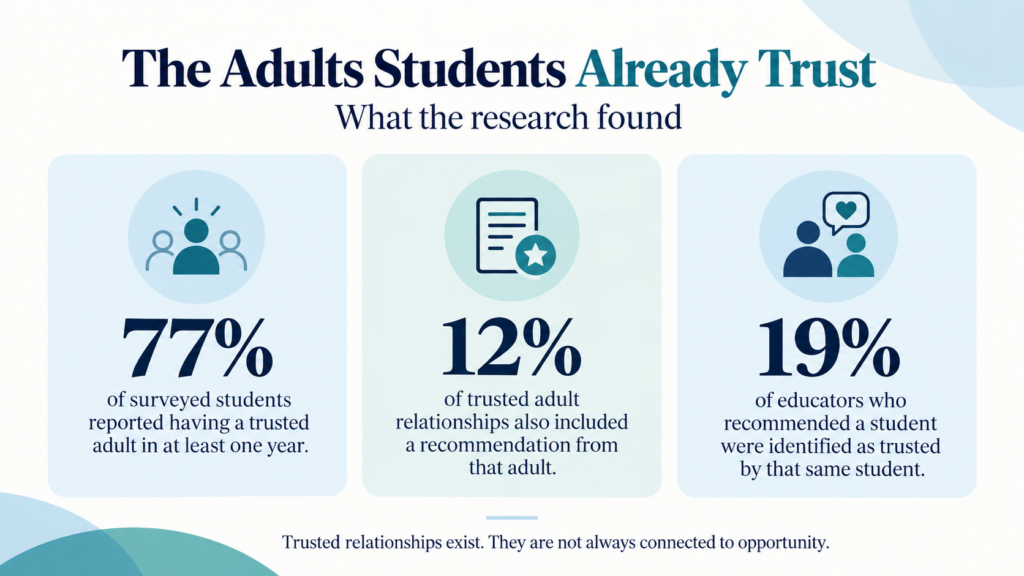
That gap is incredibly important because it points to an opportunity hiding in plain sight. Schools may already have many of the relationships they need. What they may not have is a system for connecting those relationships to the decisions and opportunities that matter.
A student might trust the soccer coach more than anyone else in the building. That coach may know the student’s aspirations, family circumstances, confidence, and worries, but may not know that the student is academically prepared for an advanced course. A counselor may know that a student qualifies for dual enrollment, but not that another adult has a relationship strong enough to help the student overcome their hesitation.
The information exists. The relationship exists. The opportunity exists. They are just not consistently connected.
What the findings suggest about opportunity
The analysis found that students who identified a trusted adult were 10 to 20 percent more likely to be enrolled in advanced courses. They also had GPAs approximately 0.2 points higher on average, with a larger difference among Latino students. Those are meaningful associations, but they are not proof that having a trusted adult caused those outcomes. Students who are already doing well academically may find it easier to form relationships with educators. Strong relationships may also contribute to academic confidence and success. Both may be true at the same time.
That distinction is important. What this study gives us is not a simple causal story about trust. It gives us a richer picture of relationships that make up the ecosystem around student opportunity. It also surfaced another challenge. Even when students of color had trusted adults, those relationships did not consistently translate into recommendations for advanced coursework.
That suggests that relationship building alone is insufficient. Adults need information. They need context. And sometimes they need guidance about what to do next.
The next frontier
This is where the research feels especially relevant to where EOS is going today. For years we have talked about the importance of identifying a student’s trusted adult, but we also need to ask what happens next.
What information should that adult have? How do we help them understand what a student wants, what barriers may be standing in the way, and what opportunities may fit? How do we give them useful guidance for a conversation that actually moves a student toward action?
The goal is not to script educators or replace their judgment. It is to help them use their relationships more strategically. That could mean helping a teacher connect a student to AP coursework. It could mean helping a counselor introduce a student to dual enrollment opportunities. It could mean equipping a coach to reengage a student whose attendance is slipping. The use case changes, but the underlying idea remains the same. Schools already have programs. They already have data. Most importantly, they already have adults building relationships with students every day. The opportunity is to connect those assets.
The Center for Trust and Transformation study helped us see just how powerful those relationships may be, how unevenly they are distributed, and how often they remain disconnected from the decisions schools are trying to influence. Sometimes the next innovation in education is not creating something new. It is helping the people already closest to students know more, understand more, and act at the moment when their relationship can matter most.
Below is the full research summary by the Center for Trust & Transformation
Other blogs you might be interested in
The Power of a More Complete Picture
By AJ Gutierrez, Alaina Boyle Ph.D., and Elizabeth Sykes For more than a decade, Equal Opportunity Schools has been asking a deceptively simple question: Who are schools missing? Schools have more information about students than ever before. We know their
Learn More
The Adults Students Already Trust: Research with the Center for Trust & Transformation
By: AJ Gutierrez, Alaina Boyle Ph.D., and Elizabeth Sykes Schools invest enormously in people. Teachers, counselors, coaches, school leaders, advisors, and other staff members spend every day building relationships with students. But how often do we actually know which relationships
Learn More
EOS Welcomes Three New Members to Board of Directors
This month, Equal Opportunity Schools welcomed three new members to our Board of Directors. With decades of leadership across industries including education, healthcare, and technology, our new board members each bring a wealth of experience and unique perspectives to advance
Learn More