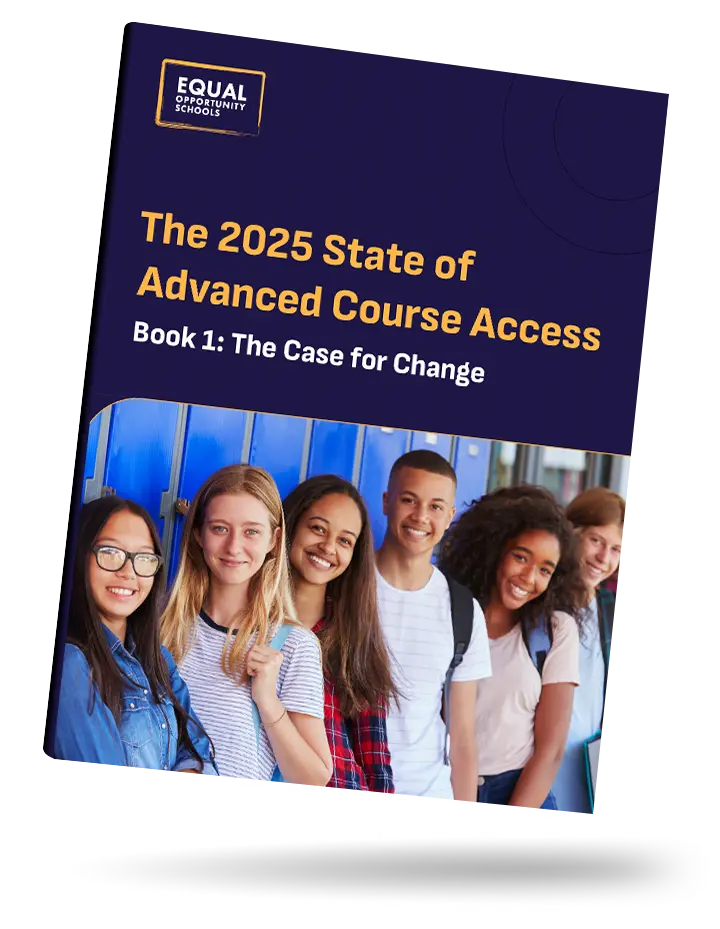
The 2025 State of Advanced Course Access
A nation of aspiring students and a major “catch 22”
High school students have big ambitions—but outdated systems aren’t keeping up. Across the country, students are navigating an invisible “ambition-access gap” that keeps them from the courses that open doors to college and careers.
In our new two-part research series, we uncover the patterns and offer actionable strategies for K-12 leaders. Book 1 explores the challenge, book 2 explores solutions.


The stakes are high- our communities need a strong talent pipeline
By 2040 the U.S. will need to add or upskill more than 20 million STEM‑capable workers to stay globally competitive. This is especially crucial in industries like AI, space tech, biomedical innovation and energy — which will drive economic growth and national security.
Advanced courses help drive college readiness, but access is uneven
With a need to improve the talent pipeline, advanced coursework can play a role but access is uneven.
When middle or high school students complete rigorous college-level or college-prep courses like Advanced Placement (AP), dual enrollment (DE), International Baccalaureate (IB) and Cambridge they unlock benefits beyond academics.

Financial savings

Exploration of majors or careers

Better prepared

Development of key skills

Increased confidence and maturity
Understanding who’s in the seats and who’s not helps educators tailor outreach strategies
With all these powerful benefits on offer, there’s an elephant in the room.
The big issue is that these benefits land unevenly for students based on their backgrounds.
While there is national debate about spotlighting differences, especially by race, EOS’s experience shows that because students are different, outreach strategies must be different. Understanding the access gap is therefore crucial.
Access based on race
59% of Asian students and 46% of White students are enrolled in advanced courses, compared to just 30% of Black/African American students and 29% of Hispanic/Latinx students.
Plus access based on Income
Students from lower-income backgrounds are 19% less likely to be in advanced courses than their middle- and upper-income peers.
Access the benchmark data every district leader needs - see where you stand.
Share it with your team to start the discussion for your schools.